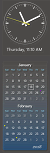
 - appointment details are shown on mouse-over.
The calendar uses your local settings, so the first day of the week, the months and the weekday names ar localized.
Notice the color gradient - the calendar widget can use a solid color or a color gradient, including partial transparency!
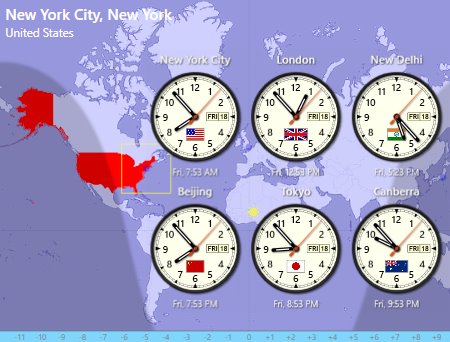
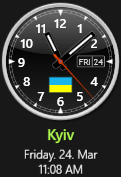
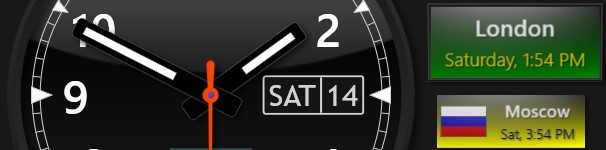
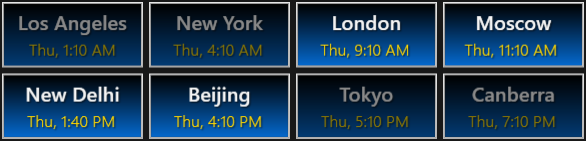
A mouse click at the clock shows or hides the main window with several clocks for other cities and time zones.
This is a recommended setting, but you can also just have the main window with multiple clocks - hidden by default or visible all the time.
- appointment details are shown on mouse-over.
The calendar uses your local settings, so the first day of the week, the months and the weekday names ar localized.
Notice the color gradient - the calendar widget can use a solid color or a color gradient, including partial transparency!
A mouse click at the clock shows or hides the main window with several clocks for other cities and time zones.
This is a recommended setting, but you can also just have the main window with multiple clocks - hidden by default or visible all the time.

Kolbus Da 36 Manual Portable
In the dimly lit corner of a bustling bindery in the late 1980s, the Kolbus DA 36
. It wasn't just a book of instructions; it was a map to the machine's soul. When the DA 36 would "hiccup"—perhaps a misfeed in the twin hopper board feeder—Elias didn't panic. He would pull out the manual, its pages brittle and smelling of old ink. He knew by heart the section on Mechanical Speed Kolbus Da 36 Manual
2.1 Key Stations
The DA 36 is typically configured with the following stations: In the dimly lit corner of a bustling
Final recommendation: If you run a Kolbus DA 36, keep a laminated copy of the lubrication chart and the timing diagram attached to the machine’s main frame. Store the full manual in a clean, dry office—not on a greasy shelf in the bindery. And if you own a copy, consider scanning it and sharing it with a non-commercial archive. This knowledge is too valuable to lose to entropy. Original manual: No light curtains or two-hand controls
The DA 36 is legendary for its durability; many units built in the 1980s are still in active production today, running at speeds of 36 cycles per minute. Because these machines are entirely mechanical, the original manual remains the only way for modern technicians to understand the intricate gear timings and vacuum settings needed to keep them running.
Clean the gluing unit and rollers thoroughly after every shift to prevent glue buildup.
- Original manual: No light curtains or two-hand controls. Safety relies on mechanical guards.
- Modern compliance: You must add an emergency pull-cord and a motor brake. Refer to ISO 12100.
- Electronics: The original manual’s relay logic can be replaced by a PLC (e.g., Siemens S7-1200). The manual’s timing chart (page 43) is invaluable for programming the PLC’s sequence.
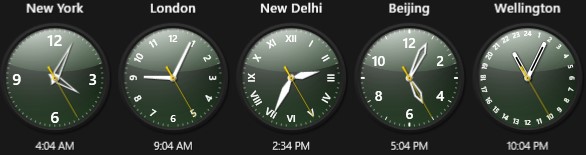 This world clock features 13 variations of hour/minute hands and 10 variations for second hands available and 6 variations for numerals: 4/6/12 positions upright, 12 positions rotated, 4/12 roman numerals.
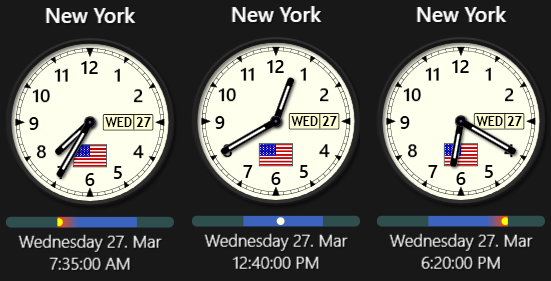 The sky strip is an additional indicator for the day/night status of a city.
It shows a symbolic representation of the sun, moving at the sky from sunrise to sunset.
The height is adjustable (in the screenshot the height is set to 15 of 1..20). During the night the strip is shown black.
For users on the southern hemisphere of the earth the direction can be changed from left->right to right->left.
The sky strip is an additional indicator for the day/night status of a city.
It shows a symbolic representation of the sun, moving at the sky from sunrise to sunset.
The height is adjustable (in the screenshot the height is set to 15 of 1..20). During the night the strip is shown black.
For users on the southern hemisphere of the earth the direction can be changed from left->right to right->left.

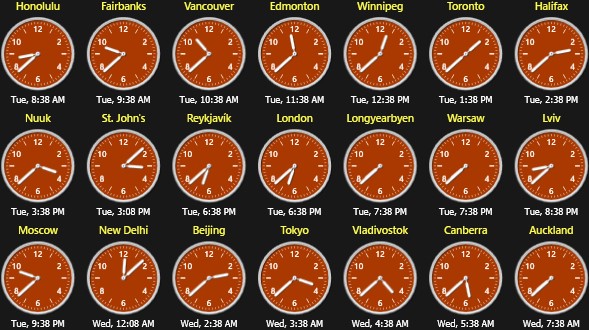 The included city database contains every city with a population of 15,000+ and every capital city.
Even an array of 21 world clocks like in this screenshot is no problem for Sharp World Clock, it can easily handle that and many more!
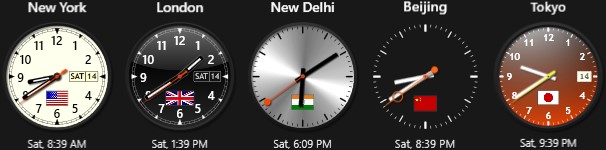
The clocks in the picture are using the same design, but this is not required.
After assigning a general design template to all clocks, you can make changes to some clocks, to make them look differently:
The included city database contains every city with a population of 15,000+ and every capital city.
Even an array of 21 world clocks like in this screenshot is no problem for Sharp World Clock, it can easily handle that and many more!
The clocks in the picture are using the same design, but this is not required.
After assigning a general design template to all clocks, you can make changes to some clocks, to make them look differently: